Lithuania – 2026 Tax Comparison (MB vs UAB company types)
A clear, numbers-based comparison of MB vs UAB company types in Lithuania, showing how taxes, social contributions, and dividends differ for solo founders in 2026.
January 23, 2026
Published 29 May 2026
Europe has spent the last decade talking about decline. Yet quietly — almost suspiciously quietly — the Baltic states have been doing something rather unfashionable: growing real wealth, rapidly.
Latest long-term data on real wealth creation across Europe confirms something we’ve been saying for years: the Baltic states — and increasingly Poland — are absolutely outperforming much of Western Europe. Lithuania in particular has emerged as one of the strongest long-term performers in the EU, with real income growth over the past two decades dramatically exceeding many of Europe’s traditional “premium” destinations.
Meanwhile, some of the old European heavyweights appear to have spent the same period aggressively regulating themselves into stagnation. The data below makes the contrast difficult to ignore.
The data
Real Disposable Median Income PPP Growth across Europe, 2005–2025

How to read this: The darker the blue, the stronger the real wealth growth. The Baltic states and Poland dominate. France, Germany, and Italy — Europe’s traditional economic powerhouses — barely register. Greece declined by 20.5% over the same period. Source: PPP-adjusted median disposable income data, 2005–2025.
Lithuania, Estonia, and Poland rarely dominate international headlines. They aren’t particularly loud countries. Nobody flies to Vilnius expecting Monaco, and no one arrives in Warsaw anticipating Mediterranean theatre. What they’ve built instead is arguably more valuable: functional economies that actually work for their residents.
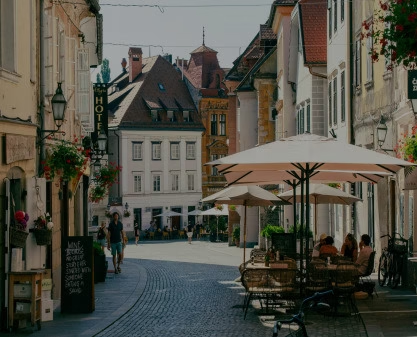
If you walk through Vilnius Old Town these days, you’ll notice an unusually healthy number of luxury SUVs weaving through medieval streets. Lithuania has become wealthy in a very Baltic way: quietly, efficiently, and with minimal self-congratulation. Though it helps when certain high-end vehicles can legally qualify as commercial goods vehicles for tax purposes — Lithuania occasionally has a surprisingly good sense of humour hidden inside its tax code.
Countries such as France, Spain, and Italy — all extraordinary places culturally — have seen comparatively weak real wealth growth over the same period. In many cases, ordinary residents are effectively treading water financially. France’s 3% real income growth over twenty years is not a typo.
Of course, those countries still offer remarkable food, climate, lifestyle, history, and generally better wine than Lithuania is likely to produce any time soon. But economically, the picture is less romantic. Over-taxation, rigid labour systems, housing pressure, slow bureaucracy, and decades of structural complacency are beginning to show.
This shift explains why we are seeing growing international interest in Lithuania and the wider Baltic region from investors, entrepreneurs, financially independent residents, remote professionals, and younger Europeans quietly relocating north-east. They are discovering something unexpected: you can access the European Union, maintain an excellent quality of life, and participate in an economy that actually feels like it’s moving forward.
Lithuania in particular has become one of Europe’s most underrated residency and investment jurisdictions. It combines:
While Southern Europe increasingly records summer temperatures somewhere between “slightly uncomfortable” and “surface of Mercury,” Northern and Eastern Europe are quietly becoming more attractive from a livability perspective alone. One suspects that in the coming decades, avoiding forty-degree summers may become a more compelling relocation factor than previously appreciated.
A functioning economy and the ability to sleep in July without melting into patio furniture is a surprisingly strong combination.
The story of European wealth and growth is changing. For decades, prestige and opportunity were assumed to flow automatically toward Western Europe’s traditional capitals. Now, increasingly, the data suggests something else: the countries once viewed as “emerging Europe” may actually be becoming Europe’s most functional and prosperous societies.
Not flashy. Not loud. Just increasingly effective. And in the long run, effectiveness tends to compound — which, coincidentally, is exactly how wealth creation works too.
My Gateway to Europe
Thinking about relocating or investing in the Baltics?
We help investors, entrepreneurs, and financially independent residents structure their European strategy — residency, taxation, property, and long-term wealth planning in Lithuania and the wider Baltic region.
The latest industry news, interviews, technologies, and resources.